
Flagler County Three-Day Release Records
No official Flagler County three-day release feed was found. The sheriff’s Inmate Inquiry can find former detainees, but it searches people and bookings rather than a rolling release cohort. Its Booking From and Booking To fields filter admission dates. They do not answer who left Perry Hall during the same span. A Friday-to-Monday booking filter could omit someone admitted the prior week and released on Saturday.
The correct three-day method depends on the scope. For one person, leave In Custody unchecked, open the right booking, and compare its actual Release Date with the selected 72-hour interval. For everyone released, ask FCSO for its maintained Commitment and Release List or release log from a precise starting timestamp to a precise ending timestamp. This produces a defensible window without pretending the public search has a release-date filter.
Check Flagler County 72-Hour Releases
Write down the exact interval before searching. “The last three days” can shift while a request is handled, while fixed timestamps do not. For a person-specific search, the booking number is the best key. When it is not known, compare the name, subject number, birth date, physical descriptors, and booking date to avoid selecting the wrong person.
- Open the FCSO Inmate Inquiry. Enter a name, subject number, or booking number.
- Leave In Custody unchecked. The checked box deliberately limits results to people who are still jailed.
- Open the matching subject and the correct booking history. Read the populated Release Date rather than the grid’s Scheduled Release Date.
- Compare the actual timestamp with the fixed 72-hour interval. Repeat for each known person when only a few names are at issue.
- For the full group, submit a request through FCSO NextRequest for the existing release report between the two timestamps.
- Ask for release date and time, booking number, and release disposition or destination if maintained. Request electronic copies and an advance cost estimate.
The Flagler County 24-hour release page narrows the same process to a single-day interval. Use that route when older events are not needed.
Flagler 72-Hour Release Fields
The public result grid and the booking detail do different work. Grid fields help identify a person, while the booking history confirms a completed county departure. The actual agency release log may contain more fields, but only maintained Flagler fields should be requested. The GS2 schedule’s general description is not a promise that every listed example field appears in the local report.
| Field | How to read it |
|---|---|
| Name and subject number | Identify the person within FCSO’s system. |
| Booking number | Separates one jail stay from other bookings for the same subject. |
| Booking Date | Shows when the stay began, not whether release occurred in the three-day window. |
| Release Date | Confirms when the selected Perry Hall booking ended. |
| Scheduled Release Date | May be blank and remains a forecast rather than proof of departure. |
| Bond and court fields | Provide context when populated; the clerk docket remains the legal source. |
| Disposition or destination | Request the maintained value when the public detail does not state where the person went. |
The official historical booking source illustrates the actual Release Date inside booking history.
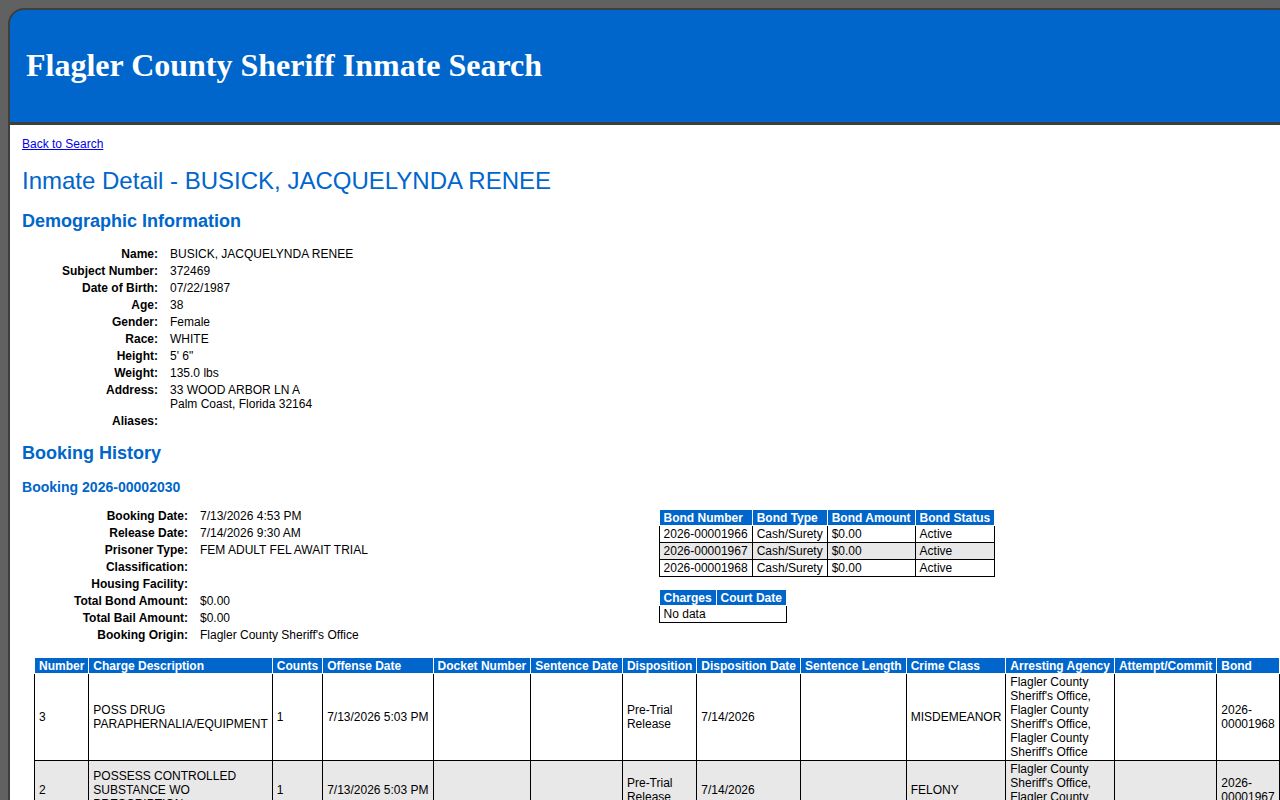
A booking detail confirms one release. It still cannot list every person whose older booking ended during the same three-day span.
Flagler Weekend Release Windows
A fixed 72-hour request can bridge Friday, Saturday, Sunday, and part of Monday without relying on when someone was booked. That is its main value. The window captures departures from older bookings as long as the actual release time falls between the stated endpoints. It can also cover a holiday closure period, but no official source reviewed promises a special holiday report or different FCSO posting cadence.
Court authorization and physical departure are separate events. FCSO accepts cash and surety bonds around the clock, yet booking staff must finish release processing. A dated Perry Hall brochure says processing time depends on the number of people in Booking and gives no fixed gate hour. Therefore, a bond posted late in a weekend does not supply the final release timestamp. Use the historical booking field or a direct jail confirmation.
When the person is known, the Flagler County released inmate lookup adds the court and receiving-agency checks needed to interpret the county departure.
Request Flagler Three-Day Release Logs
FCSO’s Records Unit is the source for the complete time-window report that the public interface cannot create. Ask for an existing record. A clear request might seek the Commitment and Release List or release log from 12:00 a.m. on the first date through 11:59 p.m. on the third date, with actual release times and booking numbers. Use different endpoints when the intended span is a rolling 72 hours rather than three calendar dates.
The sheriff accepts requests online and through other published channels. FCSO says reports over seven pages may involve actual extensive cost plus $0.15 per page, certified reports cost $1 per page, and extensive work begins at 15 minutes under its posted schedule. Charges can vary with the record and production effort. Florida’s public-records law uses a reasonable-time standard and allows review or redaction where an exemption applies.
The FCSO records-request source provides the live submission routes and fee policy.
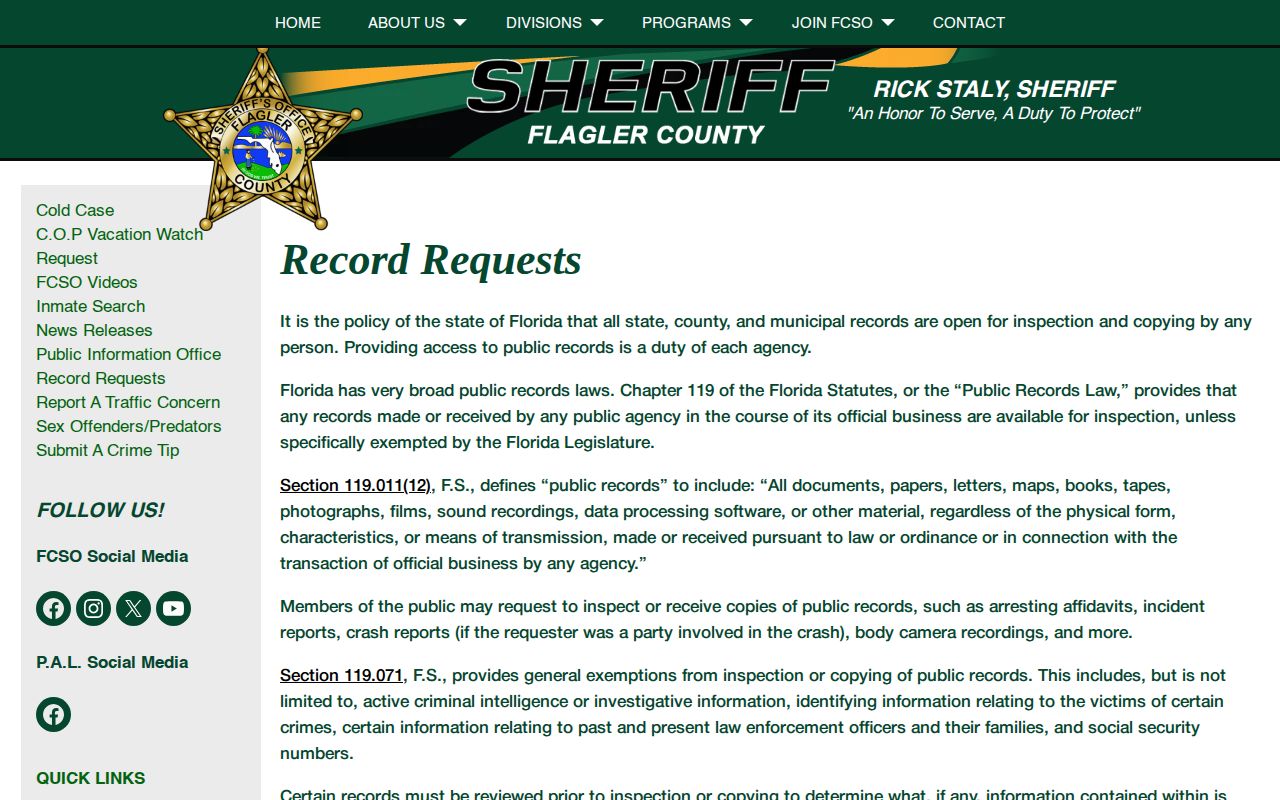
The request should identify the existing release series and exact span, which lets records staff locate a maintained report rather than create a new analysis.
For a very recent event, call Perry Hall at 386-437-4116 with the full name and booking or subject number. Florida VINE can supply alerts for a specific covered person. FDC’s Inmate Release Information serves people in state prison, not someone who spent time only at Perry Hall. BOP and ICE have separate federal scopes.
Flagler Release Range Search Limits
The optional In Custody box makes Flagler’s portal better for historical person checks than its “inmate search” label suggests. An unchecked search can reveal old bookings and their actual Release Date. Testing found records reaching at least to 2005. This is observed portal depth, not proof of completeness and not the legal retention period for every record series.
Its strongest feature also exposes its key limit. There is no Release From or Release To box. Booking date filters answer who entered during a span. A 72-hour release question asks who departed during a span. Mixing those groups can both miss relevant people and include current detainees, so a booking-date result should never be presented as the county’s three-day release list.
Note: Online archive depth may differ from agency retention, which follows the applicable state schedule and any active legal or administrative hold.
Flagler Release Destination Checks
A completed Release Date closes one Flagler County booking. It does not answer where the person went. Bond, dismissal, a court order, or completion of county time can result in community release. A prison commitment sends the person into FDC. Another warrant may produce a county or federal transfer. An immigration detainer can also turn the local departure into a handoff.
| Record clue | Next official source |
|---|---|
| Bond, dismissal, or county sentence | Flagler Clerk docket and the FCSO release record. |
| FDC commitment | Florida Corrections Offender Network and state Date Out-Custody. |
| Federal case or transport | BOP locator or the responsible federal court and USMS channel. |
| Immigration hold | ICE Online Detainee Locator and ERO contact route. |
| Unclear destination | Request the release disposition, destination, or receiving agency if FCSO maintains it. |
Read each negative result narrowly. “Not in BOP custody” addresses BOP only, while no ICE locator match does not prove community release. The most reliable chain connects the county Release Date to the next agency record or the court disposition.
Flagler Release Record Retention
Florida’s GS2 schedule includes booking records, commitment and release lists, inmate incarceration records, and jail docket books. The cited minimum for several release-related items is measured after release, including one anniversary year, while jail docket books are permanent. Those rules govern agency retention. They do not require the public search to display every responsive record for the full period.
Flagler’s portal has shown much older historical bookings, but website depth can change. If a booking is missing, ask the records custodian for the release log or booking file and cite the person, booking number, and date range. When material is withheld or redacted, request the nonexempt portion and the statutory basis for the restriction. Do not treat a missing web result as proof that no release occurred.
Note: A certified release record or saved agency response is stronger than a portal screenshot when durable proof of the three-day event is needed.
Flagler App Three-Day Limits
FCSO promotes a current agency app, and a dated official announcement listed Mobile Inmate Search as a feature. The reviewed official sources did not establish a rolling 72-hour release feed in that app. They also did not confirm that historical released bookings or photos remain available for a fixed three-day period. The app is a supplemental person check, not the source for a complete weekend cohort.
When an app result points to a booking, match it to the official subject and booking number. Then confirm the Release Date through the historical web detail or ask FCSO for the exact release log. The FCSO homepage is the appropriate source for the current app route because an older announcement may no longer describe every live feature.