
Flagler Parole and Probation
Florida divides court supervision from release decisions. A Flagler County judge may order probation as a sentence or as part of a sentence. That person might never enter state prison. The Florida Department of Corrections, usually called FDC, administers felony probation and several forms of community supervision through Community Corrections. The Florida Commission on Offender Review, or FCOR, handles parole and certain other statutory release decisions. Calling every supervised person a parolee hides this key difference.
Parole is uncommon in modern Florida cases. Eligibility turns largely on the offense date and a narrow statutory category, not just sentence length. FCOR describes a general cutoff tied to older offenses, with limited later exceptions. Probation is far more common and comes from the sentencing court. The court docket states the legal term and conditions; the FDC active-offender record states the current operational status.
| Record type | Who orders it | Best verification |
|---|---|---|
| Probation | Flagler County criminal court | Flagler Clerk order plus FDC supervision record |
| Parole | Florida Commission on Offender Review | FCOR order plus FDC status and release history |
| Conditional or other state release | Statutory release authority | FDC record, with FCOR material when applicable |
A jail release date records departure from one booking. It does not say whether probation started, continued, or ended. Likewise, a parole date that is still presumptive does not prove the person left prison. Match the court, commission, and corrections dates before drawing that conclusion.
Verify Flagler Post-Release Supervision
Begin with the FDC active-offender search. A DC number is the strongest key. If it is unknown, use the name and compare the date of birth, physical details, offense data, and supervising location. One matching name is not enough. The record should identify the person and the office that owns the supervision file.
- Search the DC number when available. Otherwise search the full name and compare identity fields.
- Open the individual result. Record the supervision type, status, start and end dates, and office shown.
- Search the Flagler Clerk case docket for the judgment, probation order, later modification, violation filing, or termination order.
- If parole appears, review the FCOR schedule and final-order route. A scheduled vote is not a release decision.
- Contact the office assigned in the live FDC record when a current public status needs clarification.
The official active-supervision search shows what FDC currently reports. The court docket supplies the legal basis. A successful termination order is stronger evidence that probation ended than an estimated end date alone. For the broader custody and release sequence, compare the result with the Flagler County released-inmate search on the home page.
The FDC active supervision gateway shows how Florida separates community records from prison population records.
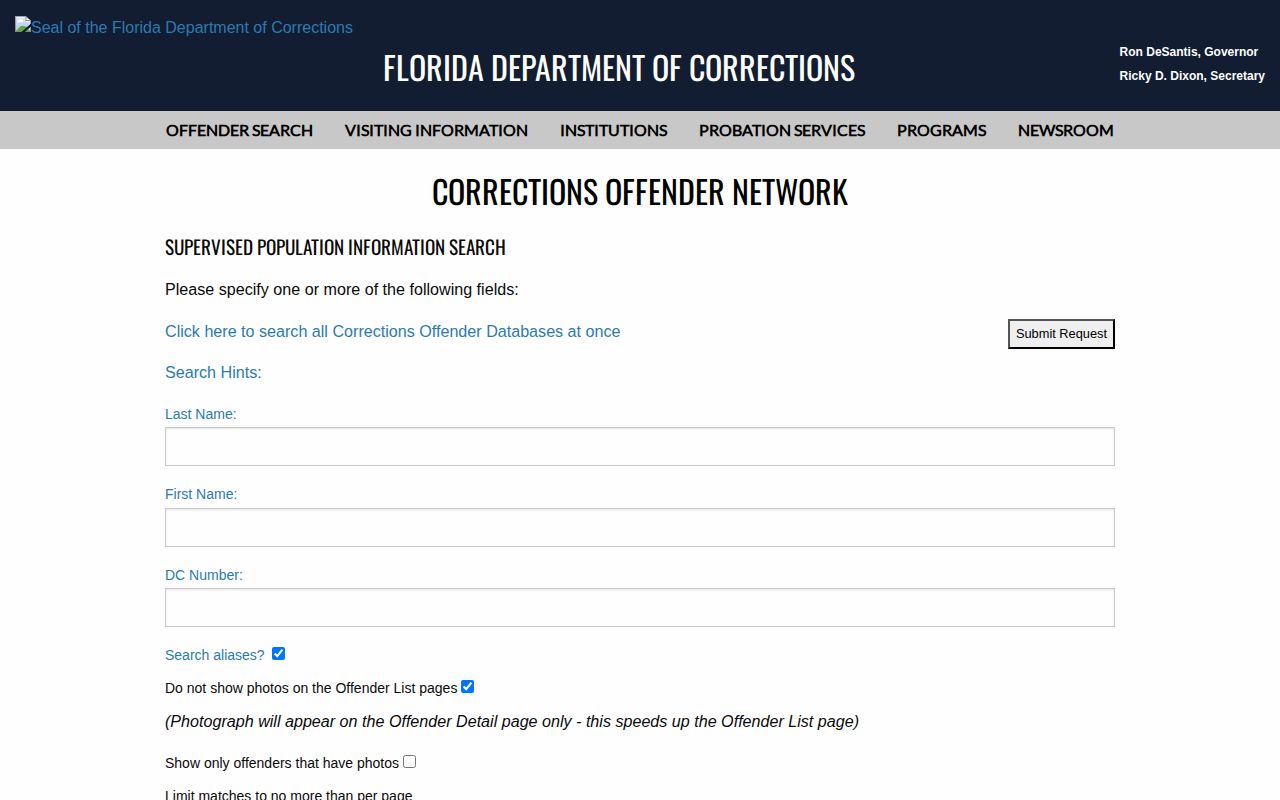
That separation matters after a Flagler County release because a person can be outside jail while still carrying an active state supervision status.
Flagler Probation Office Records
Flagler County falls within FDC Community Corrections Circuit 7. The current Circuit 7 directory lists Bunnell Office 075. Use the office connected to the person in the active-offender record, since assignments can change. This location verifies adult state supervision. It is not the county jail, the parole decision board, or the custodian of the original Flagler release sheet.
FDC Community Corrections, Bunnell Office 075703 East Moody Boulevard, Suite 6
Bunnell, FL 32110
Phone: 386-437-7575
Fax: 386-437-8211
Provide the DC number and full identifying details when calling. Ask whether the public record lists active supervision and which office holds the assignment. Staff may route a request for a maintained public record, but protected case-management details are not made public merely because someone asks. FDC Probation and Parole Field Services also publishes 850-717-3444 for general field-services questions.
The Circuit 7 office page gives the official Flagler County supervision contact.
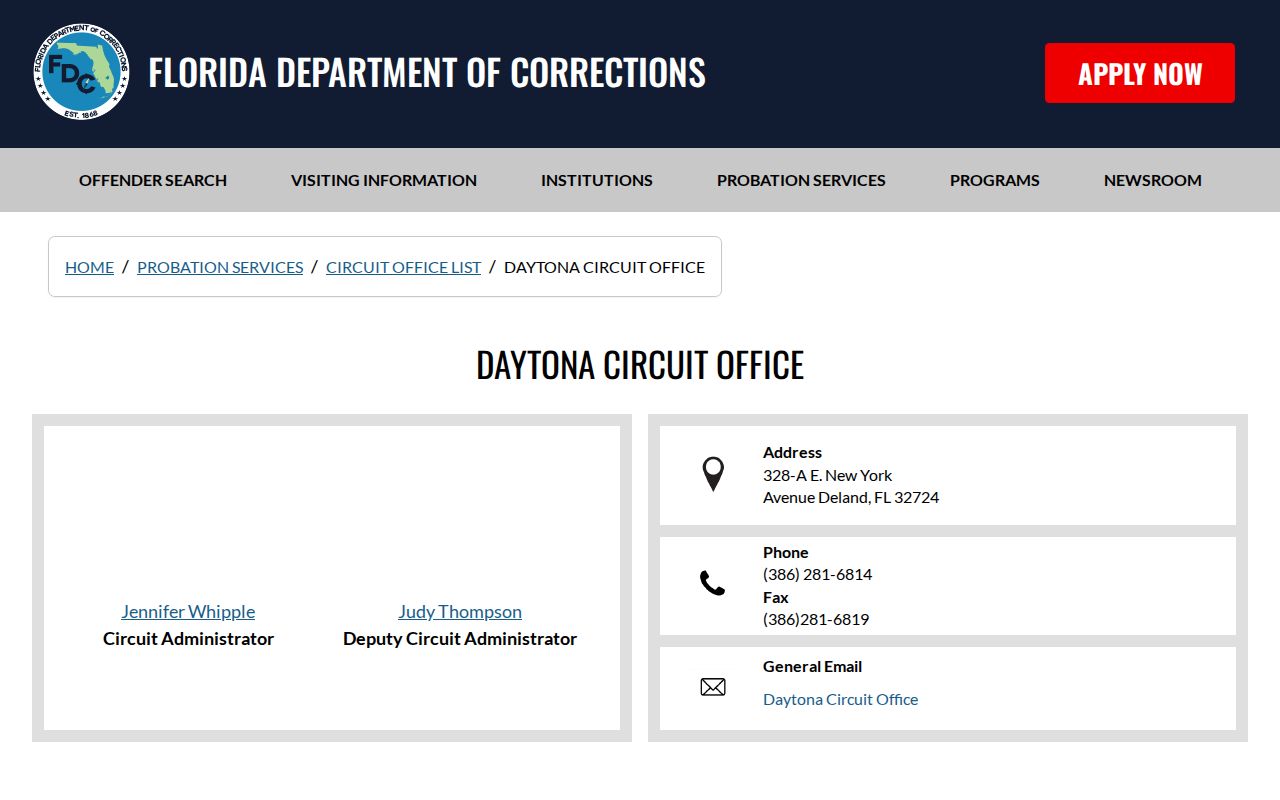
The office listing is a routing source. The individual FDC record still controls which office is assigned to a particular supervision case.
Note: A supervision office is not a detention facility, and an active record does not mean the person is currently jailed.
Flagler Supervision Status Terms
FDC status words carry specific meanings. Active supports that the person is in community supervision. Active Suspense can mean the person is jailed or otherwise unavailable, so it is not proof of a community release. Absconder means FDC reports unknown whereabouts or unavailability and a violation warrant. It does not, by itself, establish a new conviction. The Flagler Clerk docket may show the violation affidavit, warrant, modification, or revocation proceeding.
- Probation
- Court-ordered supervision that may exist without a state-prison release.
- Parole
- Supervised release authorized for a limited parole-eligible Florida prison population.
- Absconder
- A person reported unavailable to supervision, often with a violation warrant.
- Revocation
- An official action ending supervision because of a proven violation and imposing a new result.
- Discharge
- The formal end of the supervision term or release authority.
Conditions differ by court order and release type. Common supervision records may involve reporting, treatment, travel limits, or payment duties, but the actual order controls. Do not infer a violation from rumor or a stale status. For an urgent custody or warrant question, use the assigned office, the court docket, or the proper law-enforcement warrant unit. VINELink tracks custody events from participating agencies; it does not replace the supervision record.
Flagler County Sheriff’s Judicial Process and Fugitive Unit serves criminal process and arrest warrants, yet FCSO does not publish a complete county list of released absconders. Commander’s Reports and news posts are selective. For one person, combine the FDC status with the Flagler docket entry for a violation affidavit or warrant. A warrant can lead to a new jail booking, but the allegation and the later court result remain distinct records.
Flagler Parole Decision Records
FCOR maintains a rolling Commission Voting Schedule. The reviewed calendar contained vote, conditional medical release, and teleconference dates, with a case list when supplied. Its observed cadence can change. A calendar is only a schedule. It does not prove that parole was granted or that prison release occurred.
Florida parole eligibility is limited. FCOR identifies a general baseline for offenses committed before the state ended ordinary parole for most later crimes, plus narrow statutory exceptions. Section 947.16 sets interview timing for eligible people. An examiner may recommend a Presumptive Parole Release Date, or PPRD, and a panel acts under section 947.172. Later reviews may follow section 947.174. The PPRD is not an actual Date Out-Custody.
For available cases heard from July 15, 2015 onward, FCOR directs users through its inmate supporters and final-order instructions. Search with the DC number as the agency case number. Report the final order's own action, such as PPRD establishment, review, modification, revocation, or effective-date action. Then confirm a completed departure in FDC.
The FCOR voting calendar shows the difference between a scheduled parole matter and a completed release record.
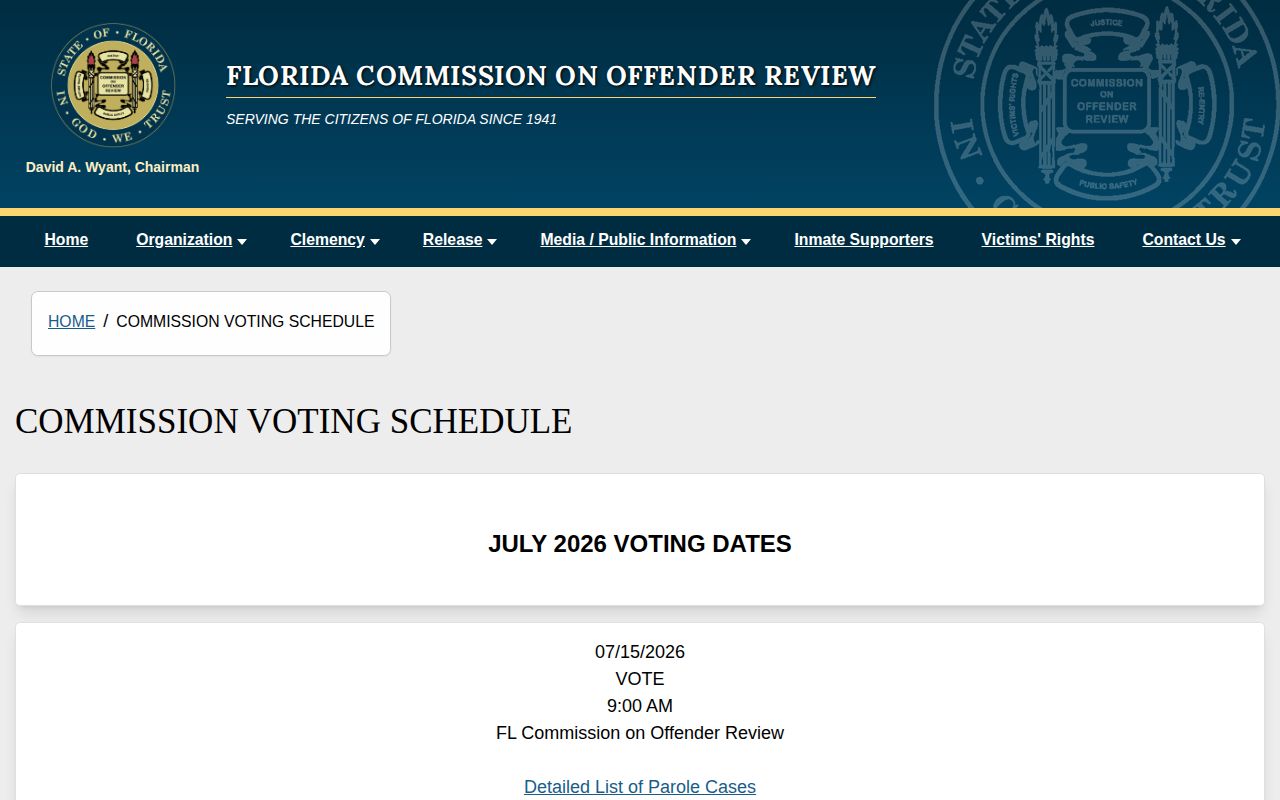
A Flagler County case on that calendar still requires a later order and an FDC custody record before actual release is confirmed.
Flagler Release Care Coordination
A Flagler County packet from 2024 describes EPIC Behavioral Healthcare's JET work inside Perry Hall. The documented grant-period approach included screening during booking, clinical services, discharge planning, and care coordination intended to continue for up to 12 months after release. FCSO separately describes SMART as an in-custody mental-health and addiction program. These named local efforts explain why treatment and care planning can cross the jail gate.
Neither program record proves that a named released person took part. Current availability must be checked because the JET description was tied to a dated grant period. A supervision record also should not be read as a treatment record. FDC status, the court order, and any voluntary care plan answer different questions and can carry different privacy limits.
Flagler Supervision Discharge Records
Supervision ends through a formal event, not merely because an expected date has passed. For probation, search the Flagler criminal docket for a successful termination, early termination, revocation, or other closing order. Compare that judicial record with FDC's end date and status. A person can also return to custody on an alleged violation while the original jail release date remains unchanged.
For parole or another commission-controlled release, use the FCOR order and FDC history. A discharge means the legal supervision obligation ended. It is different from release from Perry Hall, release from state prison, and a transfer between agencies. If ordinary online access is incomplete, request the maintained record from FDC or the Flagler Clerk under Florida's public-record process, subject to statutory exemptions.
FDC’s public-record custodian can supply a maintained supervision record when the online summary is not enough. Identify the DC number, full name, record type, and date span. For the judicial side, request the judgment, probation order, modification, violation or termination document from the Flagler Clerk. Florida public-record law permits review and copying within a reasonable time, while protected fields may be redacted. Asking for a precise existing record is more useful than asking an office to explain a person’s whole history.
A completed state-prison release and an active supervision record may appear together because community supervision follows custody. The FDC Date Out-Custody answers when prison custody ended. The supervision start, type and status answer what legal oversight remained. If both are absent, return to the county booking and court docket rather than assuming that the person had no supervision.
Note: An estimated supervision end date is not a discharge order; compare the current FDC status with the court or commission record.