
Flagler Projected Versus Actual Release
A projected date forecasts the end of custody under the facts then in the record. It may reflect a sentence, credit for time already served, lawful gain time, and the structure of several sentences. Florida Department of Corrections uses the exact public label Current Release Date for a state prisoner. Florida law also uses the term tentative release date. Both are calculated dates, not proof that the person passed through the gate.
An actual release date records a completed custody event. For Perry Hall, the historical booking detail's populated Release Date shows that the selected county booking ended. For FDC, a past Release Date supported by Date Out-Custody in the incarceration history is stronger online proof of state-prison departure. Neither record alone rules out transfer, a detainer, or custody held by another agency.
Pretrial detention follows a different path. Without an imposed sentence, there is no sentence-based release calculation. Bond, first appearance, dismissal, case resolution, another hold, and the time needed to process an authorized release all matter. FCSO accepts bond payments around the clock, but no fixed Flagler gate-release hour is published.
Find Flagler Projected Release Dates
First identify the sentence and custodian. The Florida prison search does not include a person who served only a Flagler County jail term or county probation. Conversely, a county booking date cannot substitute for the state date after transfer to FDC. The fastest route changes with that boundary.
- Search the FDC inmate information choices if the person entered Florida state prison. Use the DC number when known.
- Open the current inmate detail and preserve the exact Current Release Date. If it says “TO BE SET,” FDC review is still pending.
- For a Flagler county sentence, read the judgment and sentence in the Flagler Clerk case search. Confirm jail credit and any later amended order.
- Call Sheriff Perry Hall Inmate Detention Facility at 386-437-4116 for a current county calculation or pending release status. Ask for the correct records route when written proof is needed.
- After the expected date, confirm the actual county Release Date or FDC Date Out-Custody and check for a receiving agency.
A name-only match needs care. Compare date of birth, DC number, sentence, and case information. The Flagler County release-record search explains how to reconcile the jail booking with the court and any later custodian. A scheduled date in the FDC release search can also describe a future event, so the time direction of the date matters.
FDC’s Inmate Release Information search can be narrowed by a release-date range, release facility, county of commitment, and stated county of residence. Those filters help when a Flagler County case produced a state sentence, but they are not substitutes for identity fields. County of commitment describes the sentencing source, while county of residence is a separate data point. Open the detail and compare the conviction and incarceration history before relying on the date.
The FDC inmate search menu separates current and release-information routes.
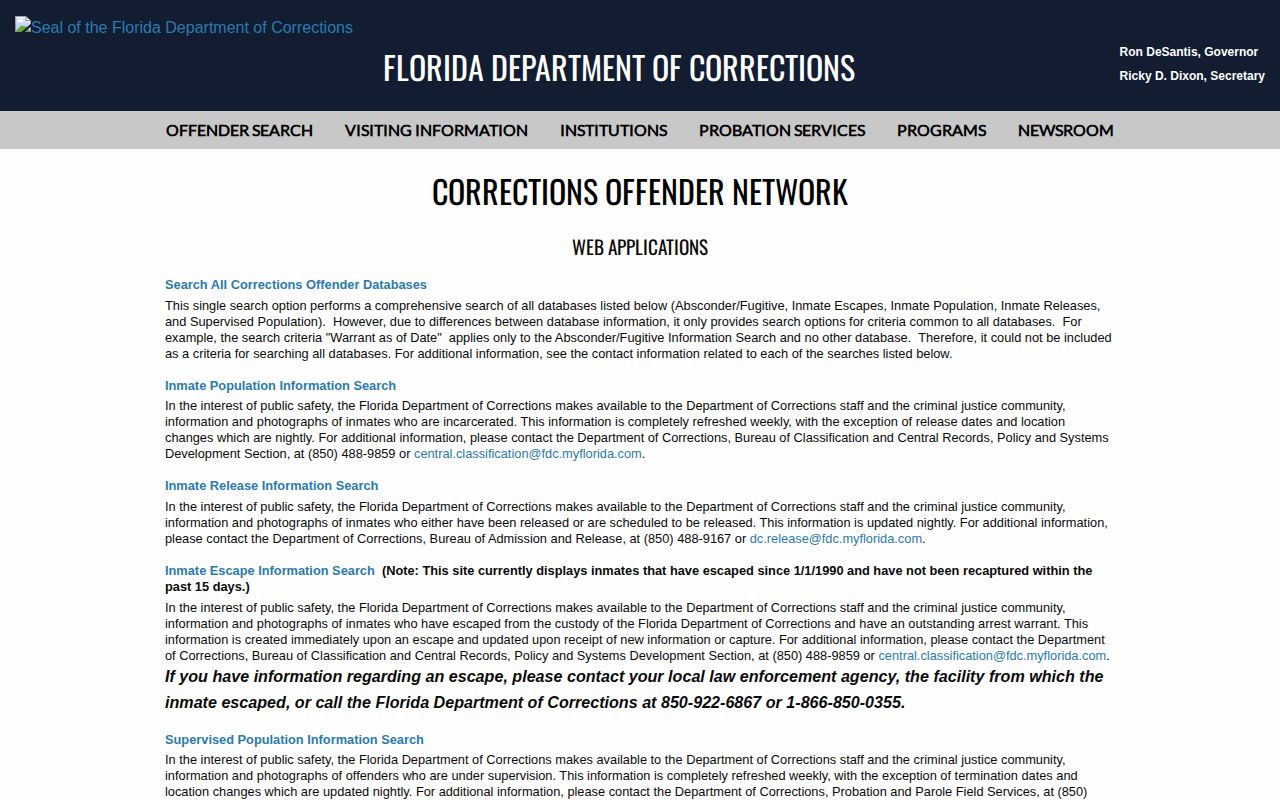
That menu should be used only for a Flagler case that resulted in Florida state custody, not for a county-only jail sentence.
Florida State Release Calculations
Florida Statutes section 944.275 directs FDC to establish a maximum sentence expiration date after lawful credits and a tentative date projected through gain time. Gain time is a credit that can reduce time served when the law and the person's record permit it. Awards and restorations can move the tentative date earlier. Forfeitures can move it later, though not beyond the lawful maximum expiration date.
For covered offenses committed on or after October 1, 1995, incentive gain time may be awarded up to ten days per month, subject to eligibility and offense exclusions. That number is a ceiling, not an automatic monthly award. The same law prevents covered gain-time awards from producing release before at least 85 percent of the imposed sentence has been served, with court-awarded credit for physical incarceration counted as the statute provides.
Section 921.002 states the Criminal Punishment Code principle for covered felony offenses committed on or after October 1, 1998. Lawful gain time may shorten actual time, but not below the 85-percent floor. A mandatory minimum or an offense-specific restriction can require more. Multiple sentences and amended judgments also change the calculation.
The FDC release-date computation rule gives the agency framework behind the calculated field.
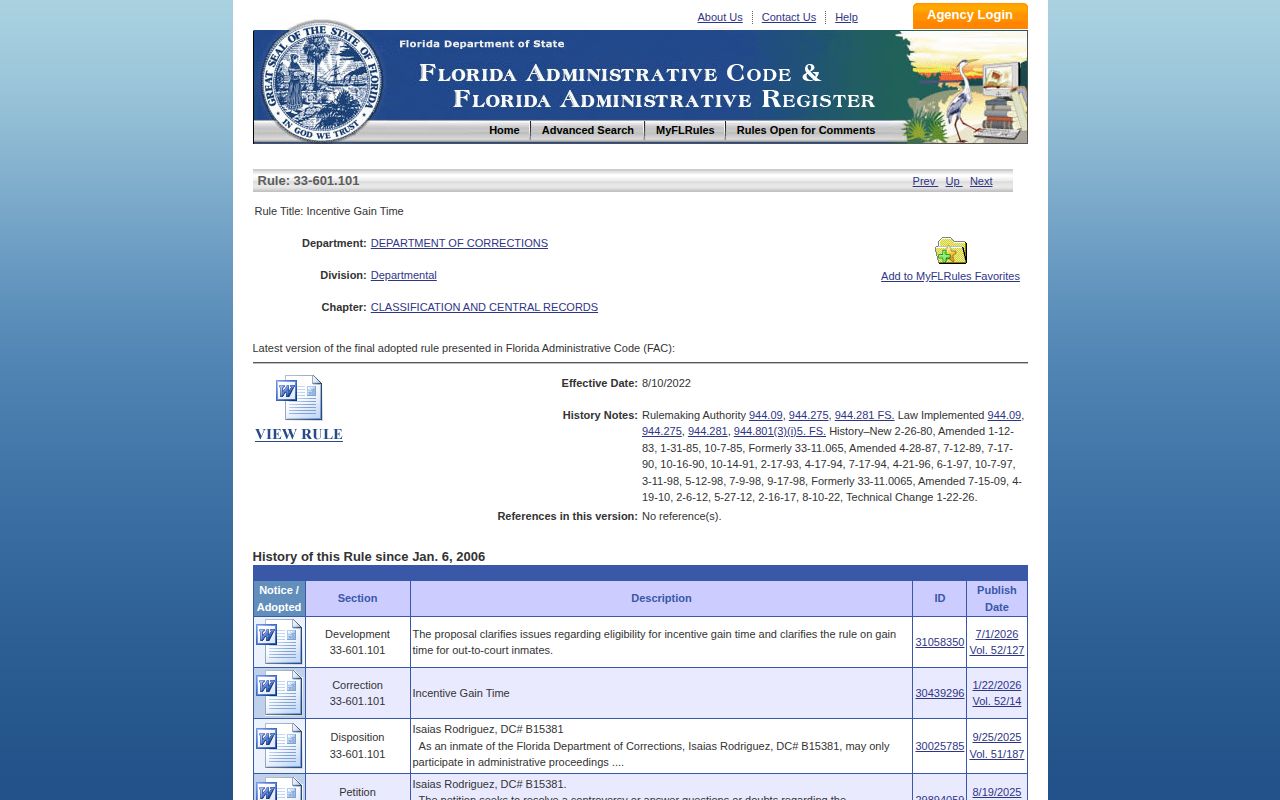
The rule supports reading the maintained FDC date rather than attempting a home calculation from sentence length alone.
Why Flagler Release Dates Change
A calculated date is a live result of the legal and corrections record. FDC warns that its Current Release Date can change through gain-time awards, forfeitures, or review. Court action can change a sentence. A new case or detainer can also keep the person in some form of custody even when the first sentence reaches its expected end.
| Change | Effect on the date or departure | Where to verify |
|---|---|---|
| Gain-time award or restoration | May move a lawful tentative state date earlier | FDC Current Release Date |
| Disciplinary forfeiture | May move the state date later | FDC calculation and record |
| Jail credit or amended judgment | Changes credited time or sentence structure | Flagler Clerk order and agency calculation |
| Mandatory minimum or offense bar | Can prevent an earlier gain-time result | Judgment, statute, and FDC record |
| Detainer or another warrant | May produce a transfer instead of community release | Holding agency and receiving locator |
| Parole or commission action | A presumptive or effective date may change before departure | FCOR order and FDC Date Out-Custody |
A Presumptive Parole Release Date is not the same field as FDC's Current Release Date. FCOR can review or modify parole-related action within its authority. Actual prison departure remains a separate FDC event. For Perry Hall, a court order or posted bond authorizes a path, but the actual Release Date confirms that processing ended.
Several sentence events can overlap. Consecutive terms run one after another, while concurrent terms can run at the same time as the judgment directs. An amended sentence, new commitment, or corrected jail-credit award can alter the underlying dates. FDC also reviews calculations, and the public field may say “TO BE SET” while that work remains open. The responsible agency’s maintained figure should control over an arithmetic estimate made from a docket summary.
Flagler County Jail Release Credit
Flagler county-only sentences use a separate regime. FDC expressly excludes county-jail-only cases from its offender data. Section 921.161 requires the sentencing court to state credit for time spent in county jail before sentencing. County-prisoner gain time comes from a different law and local administration, not FDC's prison web field.
Section 951.21 provides a county-prisoner good-conduct framework. Its statutory maximum can vary by year of the sentence and includes a possible meritorious or industry allowance on recommendation. Credit can be lost for misconduct. The law's structure should not be reduced to a promise that every county-sentenced person receives the maximum.
The Seventh Circuit Public Defender's Flagler County Jail questions page gives a narrower local statement: an eligible county-sentenced person who works and remains free from discipline may receive up to five days per month. The judgment, FCSO calculation, and current county policy control the actual person-specific date.
A county sentence also must account for credit the court awarded for physical time already spent in jail. The clerk’s judgment is the source for that credit; the jail applies the lawful county calculation. A Scheduled Release Date shown in a search grid can remain blank or change, and it is not the same as the historical detail’s actual Release Date. For a disputed calculation, request the maintained computation or speak with counsel rather than applying state-prison gain-time rules.
Flagler FDC Current Release Date
FDC refreshes current population information and photographs on its stated cycle, while release dates and location changes are updated nightly. The separate Inmate Release Information search includes both people already released and those scheduled for release, also with nightly updates. A future result is still a projection. A past Release Date paired with Date Out-Custody is the stronger public confirmation.
The FDC detail example in the image manifest shows the exact Current Release Date label.
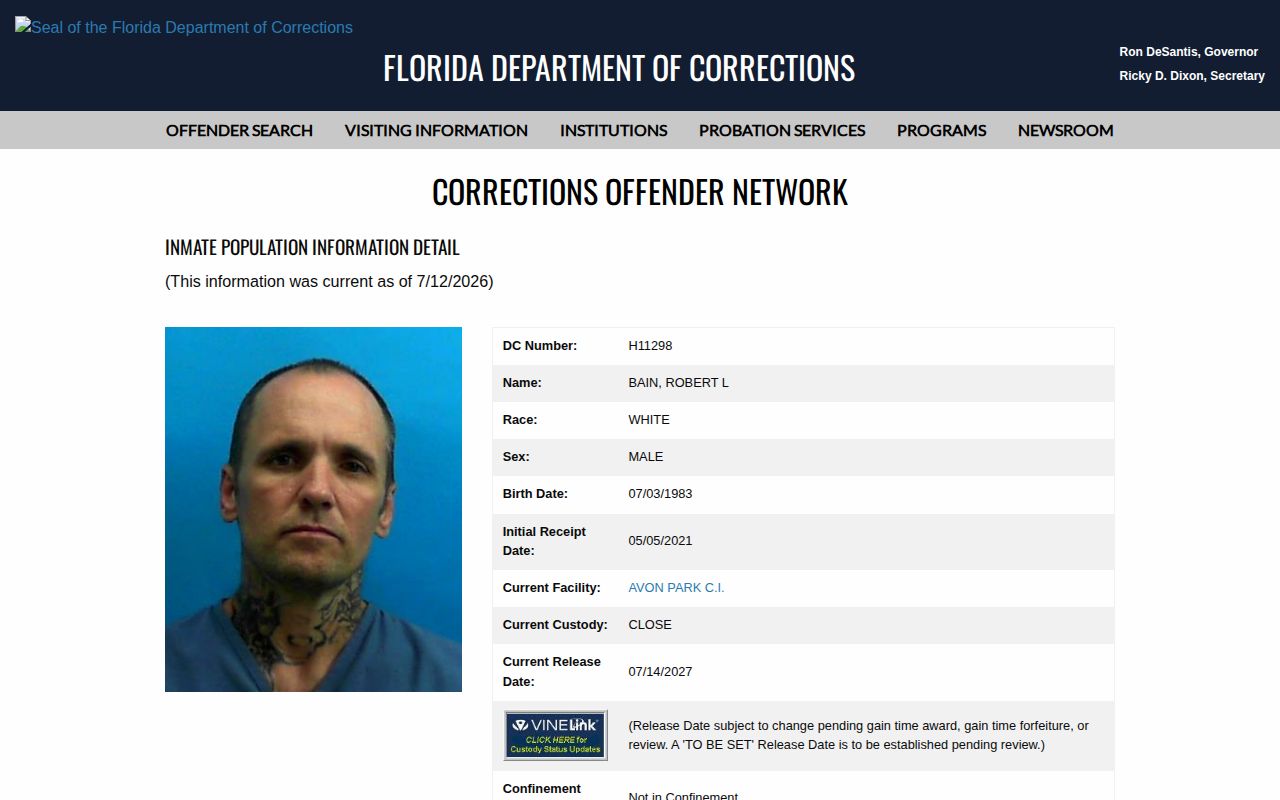
The field must be quoted as FDC labels it while being explained as calculated and subject to change.
Note: “TO BE SET” means FDC has not finished setting the date; it is not a hidden or immediate release.
Confirm Flagler Actual Release Dates
For a pending event, Florida VINE can send a release or transfer alert from a participating agency. The Flagler VINELink inmate search covers registration steps and the limits of notification feeds. An alert is a prompt to check the source record, not a certified release document.
After the date passes, use the source that held the person. Read the Perry Hall historical booking's actual Release Date for county custody. Read FDC Release Date and Date Out-Custody for a state prisoner. Then check the Flagler court docket and any receiving locator if the record suggests transfer, a detainer, or ongoing supervision. A formal release transaction can be requested from FDC or FCSO when the public view is incomplete.
FDC’s Bureau of Admission and Release publishes 850-488-9167 for state-prison release questions. It does not calculate county-only jail time. FCSO handles the Perry Hall custody record, while the Flagler Clerk keeps the sentence and later court orders. Keeping these contacts separate prevents a county booking date from being mistaken for a prison release date.
When written proof is needed, identify the person by DC number or booking number and ask for the existing admission-and-release transaction or county custody history. Request the actual date, release type, and destination if maintained. A precise request can resolve whether the projected date became a community release, a transfer, or a date later changed by legal action.
These checks preserve the key distinction: a forecast answers when release may occur, while the completed agency record answers whether it occurred and from which custody.
Note: A release from one custodian may be a transfer, so verify the destination before treating the event as community release.